
Alternative facts...
Totalitarian leaders are consumed by an urge to display their accomplishments with vulgar, tangible manifestations of their megalomania. Adolf Hitler was no different and because he was obsessed with cars, mobility, and the already existing plan for a national highway network, he made it a prominent part of Nazi propaganda.
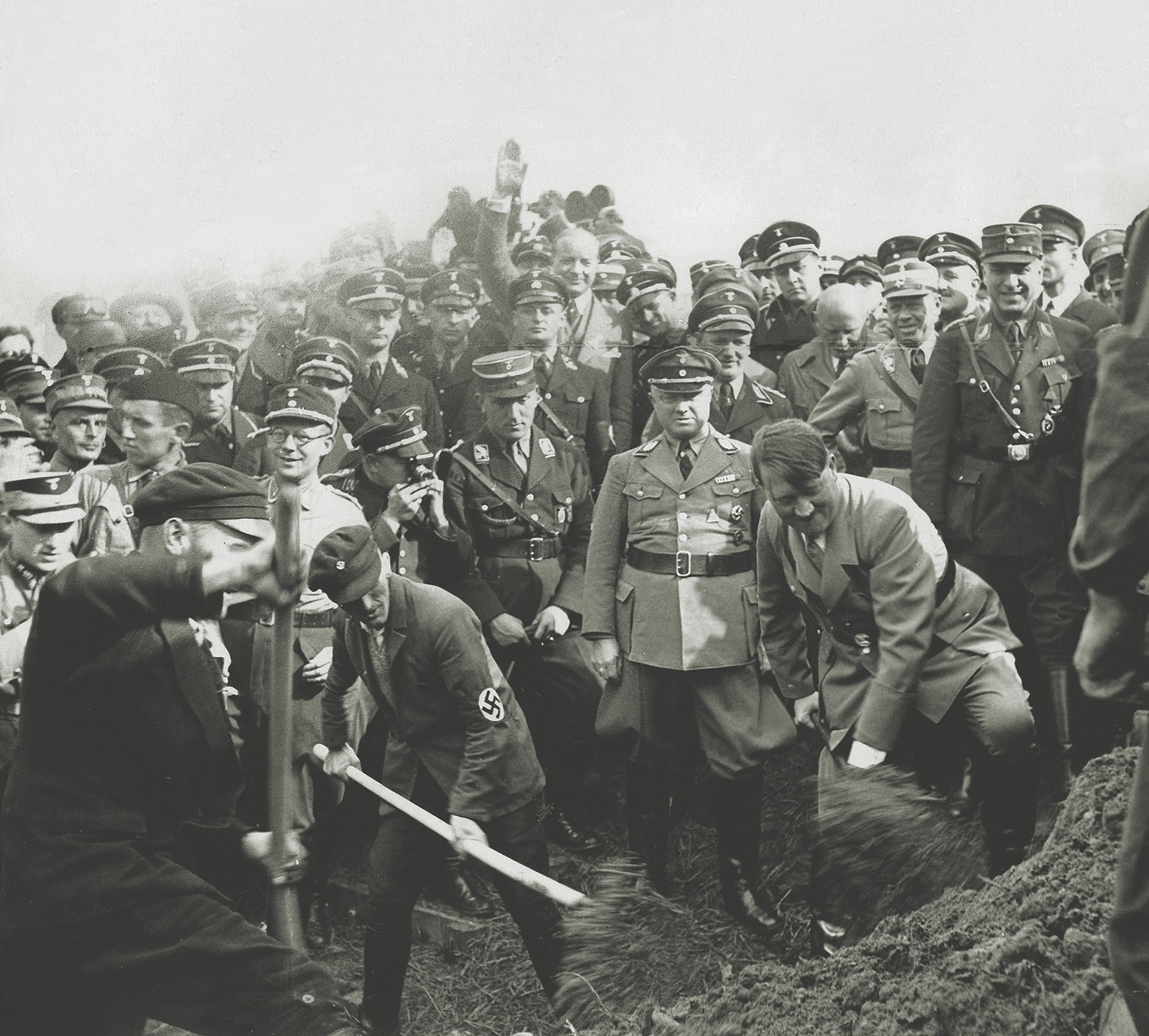
In September 1933 the recently elected Nazi party staged a ceremonial groundbreaking for the first ever stretch of autobahn between Frankfurt am Main and Darmstadt. By placing their appointed Chancellor Adolf Hitler with a spade in his hands before the assembled photographers, the Nazis claimed the project as their own and transformed it into a potent political symbol.
This laid the foundation for a stubborn myth that persists to this very day, crediting Hitler with the invention of the autobahn. History teaches us that the stretch of autobahn between Frankfurt and Darmstadt was actually part of the HaFraBa project, launched in 1926 to connect Hamburg, Frankfurt, and Basel (in Switzerland).
It is during this project that the term Autobahn was coined in 1929, in addition to the term Eisenbahn, which is German for iron road, meaning railroad track. So, autobahn simply means auto(-mobile) road, like motorway in British English and highway in the US. The official term nowadays is Bundesautobahn, which means federal motorway. In German the official spelling is Autobahn and Bundesautobahn with a capital, as all nouns are capitalized in the German language. In English this rule does not apply, and autobahn is treated as a common noun and therefore lowercase.
HaFraBa had already undertaken substantial planning and preparatory work on the route before the Nazis came to power in 1933. Hitler’s regime subsequently claimed the project, reorganised it under state control, and presented the resulting Reichsautobahn as a Nazi achievement.
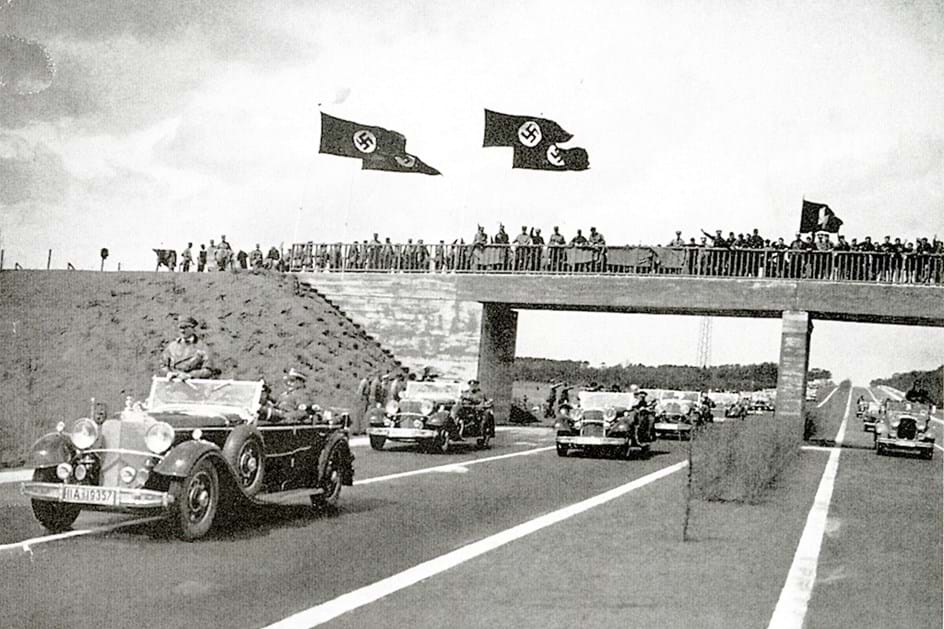
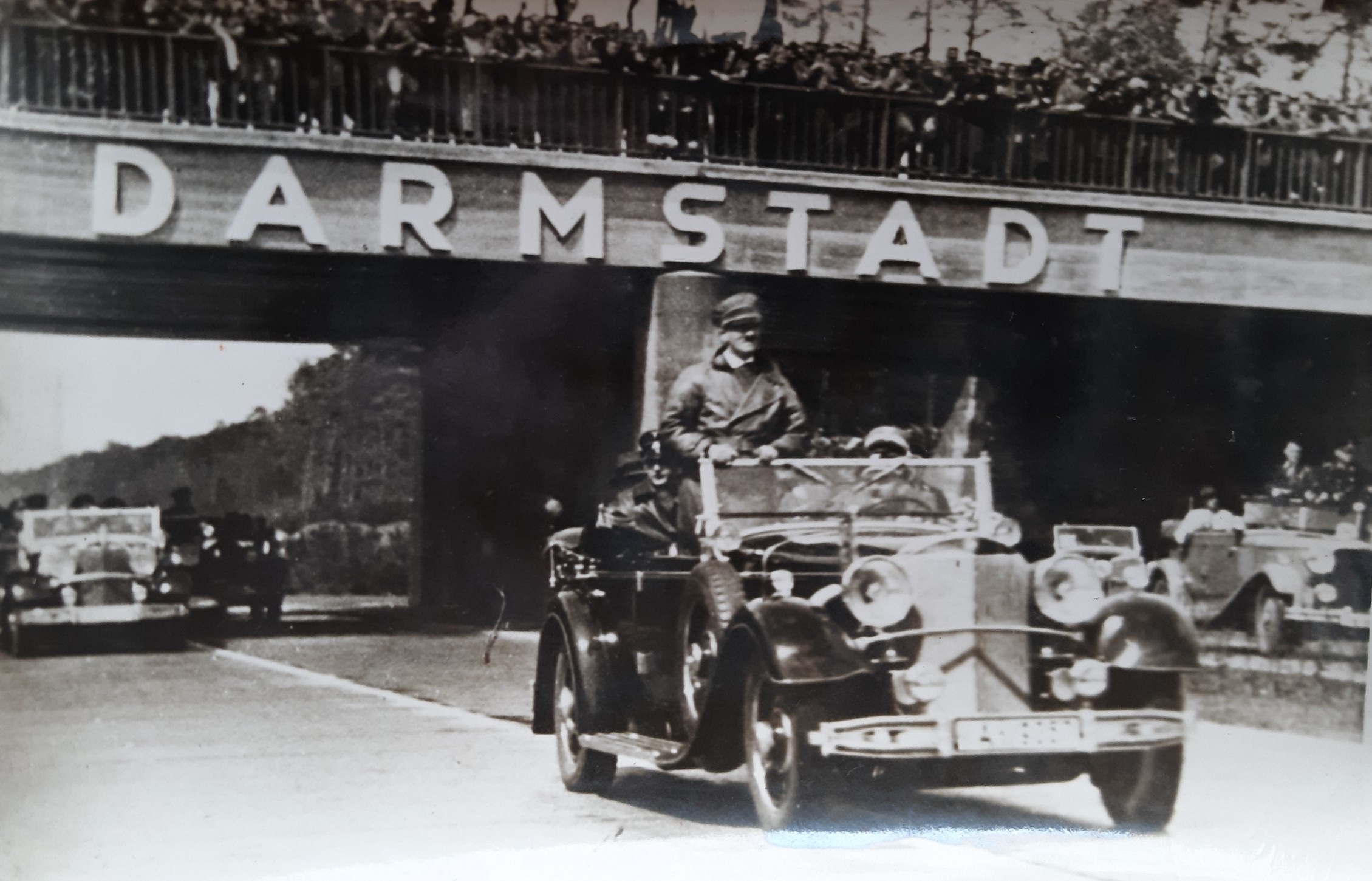
The first completed section of the Nazi Reichsautobahn programme, linking Frankfurt and Darmstadt, was opened on 19 May 1935 with all the theatricality of a national triumph. Before a saluting crowd and a battery of photo and film cameras, Hitler arrived in a Mercedes-Benz 770 leading a motorcade onto the newly completed road. This ceremony transformed a stretch of motorway into a carefully staged monument to the regime’s supposed technological and economic genius.
This straight section was later also used for high-speed record attempts by the Grand Prix racing teams of Mercedes-Benz and Auto Union, heavily funded by the Nazi regime to expand Germany’s technological arms race. In 1938 a world speed record was set by Rudolf Caracciola in a highly modified Mercedes-Benz W 125 Grand Prix car, reaching 432 km/h (268 mph), one of the highest speeds ever achieved on a public motorway. This was only hours prior to the fatal crash of Bernd Rosemeyer who tried to break this record in an Auto Union Type C V16, but was caught by a sudden crosswind at extreme speed and left the road.
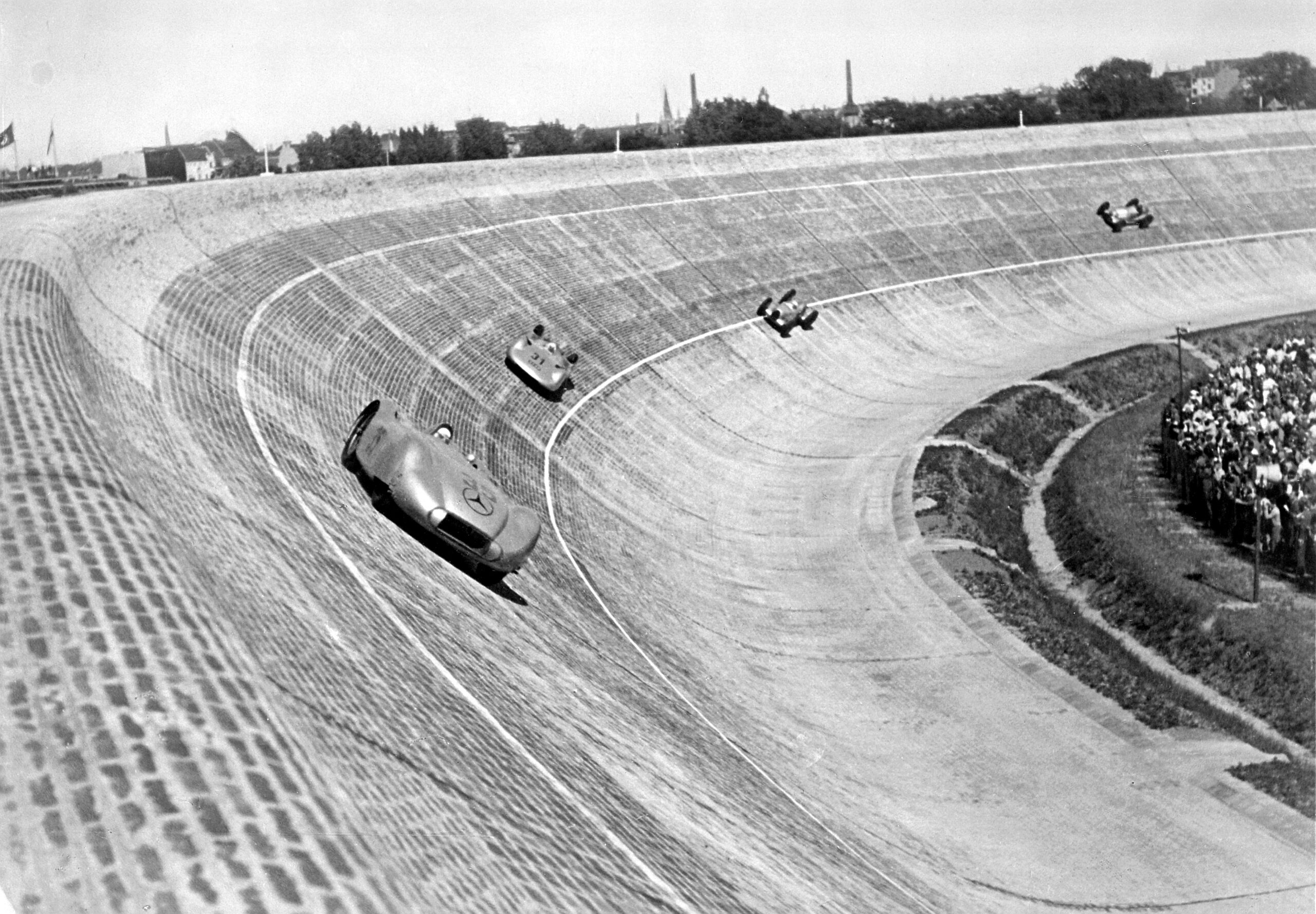
Long before the Nazi propaganda and even the HaFraBa project, Germany already had a public toll road that doubled as a high-speed testing and racing circuit. This AVUS track was opened in 1921 in Berlin as a partly privately financed road with two long straights in the form of a dual carriageway, hairpin corners at each end, and a length of 19 km (12 mi). The acronym AVUS was short for Automobil-Verkehrs- und Übungsstraße, or automobile traffic and training road.
Also preceding the Nazi regime was the A555, opened in August 1932. This 20 km (12 mi) route between Cologne and Bonn was Germany’s first publicly funded motorway. It was revolutionary because it had no level crossings or intersections. The project had been initiated by Konrad Adenauer, then Mayor of Cologne, who recognised the importance of a fast, direct road connection between the two cities. Known at the time as a Kraftwagenstraße – a road reserved exclusively for motor cars – the A555 would later become one of the earliest links in Germany’s expanding autobahn network.
The German autobahn remains one of the most efficient and best-engineered motorway systems in the world, even without considering the fact that large sections remain devoid of speed limits, leaving motorists essentially free to drive at whatever speed they deem safe and responsible. The lesson of its history, however, is that narcissists who abuse political power to inflate their own egos can never permanently control the narrative surrounding their supposed achievements. No matter how grandiose the propaganda, history has a way of stripping away the theatre and exposing the truth.
Support Motorcar Journal
Donate a tank of fuel